
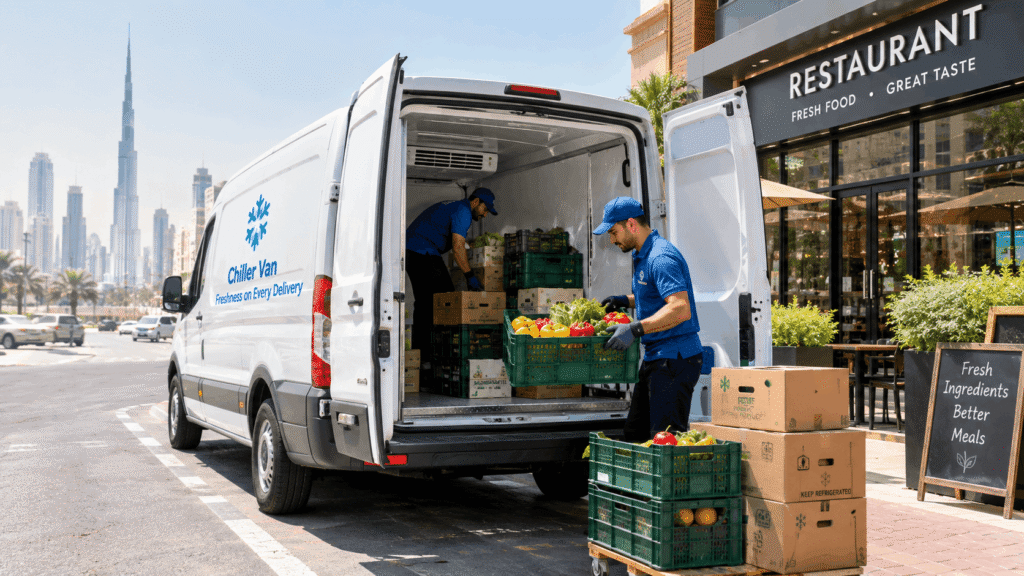
Your delivery driver just called — the produce arrived warm, and the client is refusing the order. If you run a restaurant, grocery store, or catering business in Dubai, this isn’t a one-off accident. It’s what happens when regular transport meets a climate that regularly hits 45°C in the shade. The fix already exists, and it’s simpler than most business owners assume.
Quick Answer: Dubai businesses rely on chiller vans because ambient heat and even brief air-conditioned transport can’t hold perishable goods in a safe temperature range. Chiller vans maintain a constant 0°C–8°C environment during transit, cutting spoilage, protecting food safety compliance, and preventing the financial loss of rejected or wasted deliveries.
What You Need to Know
- Dubai’s outdoor temperatures regularly exceed 40°C for five to six months a year, far beyond what standard vehicle air conditioning can offset during loading and unloading.
- Fresh produce, dairy, and meat begin losing quality within 20–30 minutes of exposure to temperatures above 8°C.
- Chiller vans use active refrigeration units, not just insulation, to hold a set range throughout the entire trip — including stops.
- Renting a chiller van is typically more cost-effective than buying one for businesses with irregular or seasonal delivery volume.
- Chiller vans differ meaningfully from freezer trucks and from vans with only ice boxes or cooler bags — the distinction affects which one a business actually needs.
Why Is Temperature Control So Critical in Dubai?
Dubai’s climate turns a 15-minute delivery delay into a spoiled order. The gap between Dubai’s ambient heat and the temperature perishable goods need is wider than almost anywhere else in the world, which is why passive cooling methods fail here specifically.
A standard van interior can climb past 50°C within minutes of the engine and air conditioning switching off — during loading, at a red light, or while the driver makes a stop. Fresh produce, dairy, and raw meat start degrading once they sit above 8°C, and the process accelerates as the temperature climbs. A chiller van solves this by running an active refrigeration unit off the vehicle’s own power, holding the cargo area in a fixed range regardless of how hot it gets outside or how many stops the route includes.
Who Actually Needs a Chiller Van?
Any business moving perishable goods more than a short walk from kitchen to counter needs one. That covers a wider range of Dubai businesses than most owners initially think.
Restaurants and cloud kitchens moving raw ingredients between central prep facilities and branches are the most obvious case. Grocery stores and supermarkets doing home delivery or inter-branch stock transfers rely on the same setup. Catering companies transporting prepared food to event venues face an even tighter window, since food is often already cooked and more sensitive to temperature swings. Florists and businesses moving temperature-sensitive medical supplies fall into the same category, even though they aren’t handling food.
[CONTENT GAP: a dedicated “which businesses need a chiller van” guide broken out by industry would strengthen internal linking here.]
What Happens Without One — The Real Cost of Spoilage
Spoiled deliveries cost more than the product itself. The direct loss is the goods, but the downstream costs are usually bigger.
A rejected delivery means a lost sale, a return trip, and often a lost customer relationship. For food businesses, repeated temperature failures can also trigger food safety violations under UAE regulations, since perishable goods transported outside safe temperature ranges are treated as a compliance issue, not just a quality one. Dubai Municipality’s food safety framework holds businesses responsible for maintaining the cold chain from storage through to final delivery, which means the transport leg isn’t exempt just because the kitchen or warehouse was compliant.
The counterintuitive part: many businesses assume the risk is highest in peak summer, but shoulder-season months (spring and early autumn) see some of the worst spoilage incidents, because staff relax cold-chain habits once it “feels” cooler outside — even though a closed van interior still overheats fast.
Chiller Van Fit Checklist — Match Your Business to the Right Setup
Use this table to match your delivery pattern to the setup that actually fits, instead of over- or under-ordering capacity.
| Business Type | Typical Temperature Need | Typical Load Size | Rental Frequency |
|---|---|---|---|
| Restaurant / cloud kitchen | 2°C–5°C | Small (up to 500kg) | Daily or several times a week |
| Grocery / supermarket | 0°C–4°C | Medium to large | Daily |
| Catering company | 2°C–8°C | Medium, event-dependent | Per-event, irregular |
| Florist | 4°C–8°C | Small | Daily or seasonal |
| Bakery / dairy distributor | 0°C–4°C | Small to medium | Daily |
Save or screenshot this Chiller Van Fit Checklist — it covers the most common Dubai business types and their baseline cooling requirements before you contact a rental provider.
Chiller Van vs. Regular Van vs. Freezer Truck
A chiller van, a regular van, and a freezer truck solve three different problems, and picking the wrong one is the most common costly mistake businesses make.
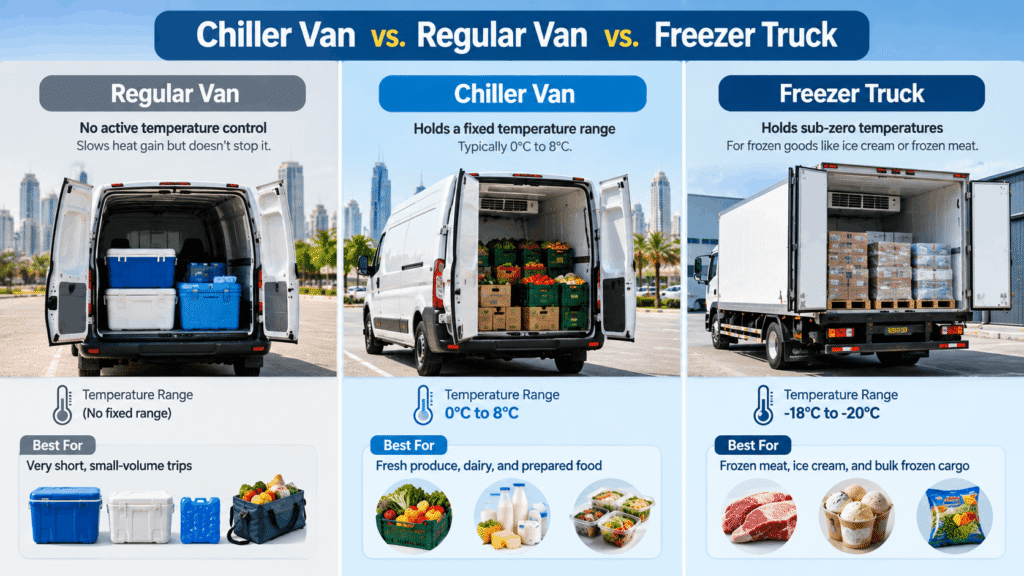
A regular van with ice boxes or cooler bags offers no active temperature control — it slows heat gain but doesn’t stop it, which makes it unsuitable for anything beyond very short, small-volume trips. A chiller van runs a refrigeration unit that holds a fixed range, typically 0°C to 8°C, suited to fresh produce, dairy, and prepared food. A freezer truck goes further, holding sub-zero temperatures for frozen goods like ice cream or frozen meat, and is usually a larger, heavier vehicle built for bulk frozen cargo rather than fresh daily deliveries.
| Vehicle Type | Temperature Range | Best For |
|---|---|---|
| Regular van (ice/cooler bags) | Uncontrolled, degrades quickly | Very short trips, small volume |
| Chiller van | 0°C to 8°C | Fresh produce, dairy, prepared food |
| Freezer truck | Below 0°C | Frozen goods, bulk cold storage transport |
Renting vs. Buying — Which Makes Sense for Your Business?
For most businesses with variable or seasonal delivery volume, renting a chiller van makes more financial sense than buying one outright. Ownership makes sense mainly when delivery volume is high and constant year-round.
Buying a chiller van means covering the upfront vehicle cost, refrigeration unit maintenance, and driver overhead even during slow periods. Renting shifts that cost into a variable expense that scales with actual need — useful for businesses with seasonal spikes around Ramadan, summer tourism, or event-driven catering demand. This is the point where a rental service like Chillfreez typically enters the picture for businesses that need reliable cold-chain transport without the overhead of owning and maintaining a dedicated fleet.
Common Mistakes Businesses Make With Chiller Van Deliveries
The most common mistake isn’t choosing the wrong vehicle — it’s treating the chiller van as a guarantee instead of a tool.
Loading a warm van and expecting it to cool cargo down in transit is a frequent error; the unit is designed to maintain a temperature, not rapidly lower one, so goods should already be cold before loading. Leaving the cargo doors open for extended periods during multi-stop routes lets warm air in faster than the unit can compensate. Assuming any refrigerated-looking van qualifies as a proper chiller van is another one — some vehicles marketed as “cold vans” only have basic insulation with no active cooling unit at all.
FAQs
Is a chiller van worth it for a small business in Dubai?
Yes, if perishable goods travel any meaningful distance — even a few kilometers in Dubai’s heat can push cargo out of a safe temperature range within 20–30 minutes. Small businesses often rent rather than buy, which keeps the cost proportional to actual delivery volume instead of carrying a fixed vehicle expense year-round.
How is a chiller van different from a regular van with ice boxes?
A chiller van uses an active refrigeration unit that holds a fixed temperature throughout the trip, including stops. Ice boxes and cooler bags only slow heat gain temporarily and offer no real control once the ice melts or the bag opens repeatedly during multi-stop deliveries.
What temperature should a chiller van be set to for fresh produce?
Most fresh produce, dairy, and prepared food need 0°C to 8°C during transport. The exact setting depends on the specific goods — dairy and raw meat generally sit at the colder end, while some produce holds better a few degrees warmer.
Can one chiller van handle both food and non-food deliveries?
Yes, as long as the van is properly cleaned and sanitized between uses. Many Dubai businesses use the same rented chiller van for fresh food one day and temperature-sensitive retail goods or medical supplies another, provided cross-contamination protocols are followed.
What happens if a business delivers spoiled food in Dubai?
Beyond the immediate loss of the order, repeated cold-chain failures can trigger food safety compliance issues under Dubai Municipality’s regulations, since transport is considered part of the cold chain, not a separate step. This can affect a business’s food safety rating.
This article covers general cold-chain transport practices for Dubai businesses. For guidance specific to your product type, load volume, or route length, consult a chiller van rental provider directly rather than relying on general temperature ranges alone.
What to Do Next
If your business handles frozen stock specifically, Optimizing Frozen Food Management in a Chiller Van covers how to manage that inside the same vehicle type. If deliveries extend beyond food — furniture, retail stock, or general goods — 5 Reasons to Choose a Chiller Van for Moving Your Goods breaks down that use case. And if your business also moves temperature-sensitive medical supplies, Medicine Delivery Van Rental in Dubai: What You Need to Know walks through the specific requirements involved.