
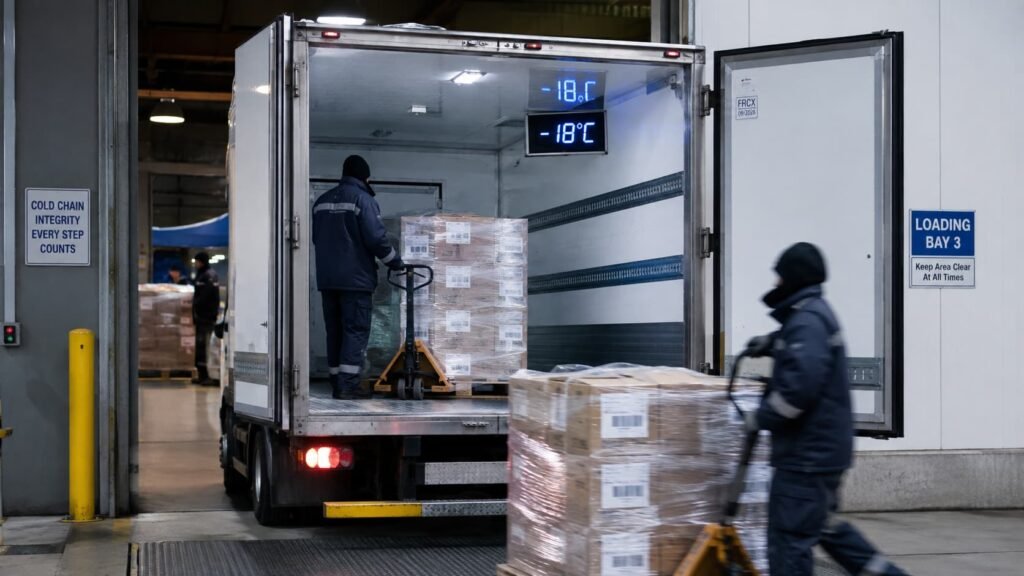
Your driver just called from a loading bay in Al Quoz, and the frozen seafood order has been sitting on the tailgate for eleven minutes because the client’s staff aren’t ready to receive it. You need to know, right now, whether that shipment is still safe — and how to stop this from happening on every delivery. Here’s exactly what the temperature needs to be, what to do in that eleven-minute window, and how to build a routine so this stops being a daily gamble.
Quick Answer: Frozen food in a chiller van must stay at -18°C or colder throughout transit. A short rise to -15°C during active loading or unloading is tolerated, but the product’s core temperature must never exceed -12°C. Anything warmer than that is a cold chain breach under UAE food safety rules, and the load is grounds for rejection.
What You Need to Know
- A chiller van (0°C to 8°C) is not the same vehicle as a freezer van (-18°C to -25°C) — using the wrong one is the single most common mistake we see.
- The -18°C target isn’t a suggestion; it’s enforced in the UAE by Dubai Municipality’s Food Safety Department and ADAFSA, under Federal Law No. 10 of 2015 on Food Safety.
- Dubai ambient temperature inside a parked, unrefrigerated vehicle can exceed 60°C in summer — your pre-cooling routine matters more than your refrigeration unit’s rated capacity.
- A written loading/staging/sealing routine prevents more spoilage than any single piece of equipment.
- Once product core temperature crosses -12°C, refreezing does not undo the quality and safety risk — you make a documented call, not a guess.
Chiller Van or Freezer Van — Which One Actually Handles Frozen Food?
A chiller van keeps cargo between 0°C and 8°C; a freezer van reaches -18°C to -25°C, and only the freezer van is built to carry frozen goods. This is the mix-up that causes the most damage claims we’ve seen, because both vehicles get casually called “chiller van” in everyday conversation across the UAE logistics trade.
| Vehicle type | Temperature range | Correct use case | Wrong use case |
|---|---|---|---|
| Chiller van | 0°C to 8°C | Fresh produce, dairy, chilled beverages, flowers | Frozen meat, ice cream, frozen seafood |
| Freezer van | -18°C to -25°C | Frozen meat, seafood, ice cream, frozen bakery | Fresh produce (over-chilling causes cell damage) |
| Ambient/dry van | Uncontrolled (can hit 25°C+ in UAE heat) | Dry, shelf-stable goods only | Anything perishable |
If your product needs to arrive frozen solid, book a freezer van by name when you request the vehicle — don’t rely on the generic term “chiller van” and assume the right unit shows up. If your goods only need to stay cool, not frozen, a chiller van is the more economical booking.
What Temperature Should a Chiller Van Maintain for Frozen Food?
Frozen food needs -18°C or colder for the entire journey, with -12°C as the absolute ceiling on core product temperature. This isn’t a UAE-specific number — it mirrors international Codex Alimentarius guidance for quick-frozen foods, which the UAE’s own food safety framework aligns with.
In practice, three thresholds matter more than one:
- Target: -18°C. Where the cargo should sit for the whole trip.
- Alert: -16°C. Where you investigate before it becomes a problem.
- Reject: -12°C. Where the load has to be treated as compromised, documented, and escalated — not quietly delivered anyway.
How Long Can Frozen Food Stay in a Chiller Van During UAE Summer?
In direct UAE summer heat, a well-loaded freezer van can typically hold -18°C for several hours of driving, but the danger window is the stationary minutes at loading bays, not the drive itself. We’ve found that product loaded at the correct starting temperature into a pre-cooled compartment tolerates short stops far better than a rushed load into a compartment that was never given time to reach target.
The number that actually matters operationally: keep staging time outside cold storage under 10 minutes per pallet or trolley. Past that, in Dubai’s May–October heat, surface temperature on exposed cartons starts climbing fast enough to matter.
The Loading Routine That Actually Prevents Spoilage
This is the checklist we use before every frozen dispatch — save or screenshot it, because it covers the exact sequence that stops temperature loss at the point where most damage actually happens: the loading bay, not the highway.
- Confirm the compartment is pre-cooled to -18°C before opening the doors. Don’t load into a van that’s still pulling down from ambient — a refrigeration unit is built to maintain temperature, not rapidly chill a hot box.
- Verify product is already at -18°C before it goes near the van. If the goods arrive warm from a cold store, the van will not fix that during a short urban delivery run.
- Stage pallets in a shaded, cold-adjacent area — never in direct sun on the dock. Even five minutes of direct Dubai sun on a carton can raise its surface temperature several degrees.
- Set a 10-minute maximum staging time per load and assign one person to track it. A phone timer is enough; the point is that someone is accountable for the clock, not just the thermometer.
- Limit door openings to one per stop and record the time each door opening starts and ends. Codex-aligned guidance treats door-opening frequency and duration as a direct control point, not a minor detail.
- Log departure temperature, and re-check at any stop over 60 minutes. This becomes your proof pack if a client disputes a delivery later.
- If a reading crosses -12°C, stop and make a documented call — don’t deliver and hope. Record what happened, what you did, and who signed off.
Common Mistakes That Cause Spoilage Claims
The single biggest mistake is booking a chiller van when the product needs a freezer van — the temperature gap between 8°C and -18°C is enormous, and no amount of ice packs closes it for a full pallet of frozen seafood.
Other patterns we’ve seen repeatedly:
- Loading warm product and assuming the van will “catch up” during transit — it usually can’t, especially on short routes.
- Leaving pallets staged in the sun while paperwork gets sorted, which quietly burns the safety margin before the van door even closes.
- No one owns the doors-open clock, so a “quick check” becomes four separate two-minute openings that add up.
- Treating a -12°C reading as a gray area instead of a hard stop, because no one wants to be the one who rejects a load.
What Happens If the Cold Chain Breaks?
If frozen product’s core temperature has exceeded -12°C, refreezing it does not restore its original safety or quality profile, and the responsible move is to document the breach and make a deliberate accept/reject decision — not deliver it quietly. Short excursions during active loading, kept under -15°C and brief, are within Codex-aligned tolerance. Anything beyond that should be treated as a genuine cold chain failure, logged with a timestamp, and escalated to whoever owns the client relationship before the goods are handed over.
UAE Food Safety Rules for Frozen Transport
Frozen transport in the UAE sits under Federal Law No. 10 of 2015 on Food Safety, enforced locally by Dubai Municipality’s Food Safety Department and, in Abu Dhabi, by ADAFSA. Both authorities can inspect temperature logs during unannounced audits, and documentation — not a driver’s word — is what counts as proof of compliance.
If you don’t operate your own fleet and need this handled for you, ChillFreez’s freezer van rental service takes on pre-cooling, monitoring, and the logging routine described above as part of the booking, so your team isn’t building this discipline from scratch on every route. Deliveries confined to Dubai city can also book directly through chiller van rental in Dubai, or chiller van rental in Abu Dhabi for routes in the capital.
If frozen food logistics is a recurring headache for your business, our newsletter covers UAE cold chain compliance updates and seasonal loading tips before they turn into a rejected shipment.
Frequently Asked Questions
What’s the difference between a chiller van and a freezer van?
A chiller van holds cargo between 0°C and 8°C, suited to fresh produce and dairy. A freezer van reaches -18°C to -25°C and is the correct vehicle for frozen meat, seafood, and ice cream. Using a chiller van for frozen goods will not keep them frozen.
How long can frozen food safely sit outside cold storage in UAE heat?
Keep staging time under 10 minutes per load whenever possible. Dubai’s summer ambient temperature inside a parked, unrefrigerated space can climb well past 60°C, so exposed cartons heat up faster than most teams expect.
Do freezer vans re-freeze food that has warmed up during transit?
Not reliably. A refrigeration unit is designed to maintain a set temperature, not rapidly pull down product that arrived warm. If goods aren’t already at -18°C before loading, the van usually can’t fix that on a short delivery run.
What documentation proves cold chain compliance in the UAE?
A departure temperature log, staging time records, door-opening timestamps, and a note of any corrective action taken. Dubai Municipality and ADAFSA can request these during inspections, and verbal assurance from a driver is not accepted as proof.
What temperature triggers a rejected frozen shipment?
Once core product temperature exceeds -12°C, the load should be treated as compromised. This is the ceiling referenced in Codex-aligned frozen food transport guidance and mirrored in UAE enforcement practice.
Is ice cream held at the same temperature as other frozen food?
No. Ice cream and similar products typically require -22°C to -25°C, colder than the -18°C baseline used for most other frozen goods, because it’s more sensitive to texture changes from temperature swings.
What to Do Next
Book the right vehicle for what you’re actually shipping — the freezer van page covers specs and rates for frozen cargo, while the chiller van page is the fit if your goods only need to stay cool. Moving larger frozen volumes than a single van handles? The freezer truck page covers bulk capacity. And if you’re booking by location, see chiller van rental in Dubai or chiller van rental in Abu Dhabi.
[CONTENT GAP: no dedicated HACCP/cold-chain-compliance article exists yet on chillfreez.com — worth writing as a follow-up piece and linking here once live.]
Pingback: 5 Reasons to Choose a Chiller Van for Moving Your Goods - Chill Freez
Pingback: Why Dubai Businesses Rely on Chiller Vans for Deliveries
Pingback: What Is a Chiller Van? How It Works & Keeps Goods Cold