
You’ve got a delivery to make, a vendor quote in front of you, and two options that sound almost identical — chiller van, freezer van — but the wrong pick either spoils your stock or wastes money on refrigeration you don’t need. Here’s how to tell them apart in the next five minutes, and which one your specific product actually needs.
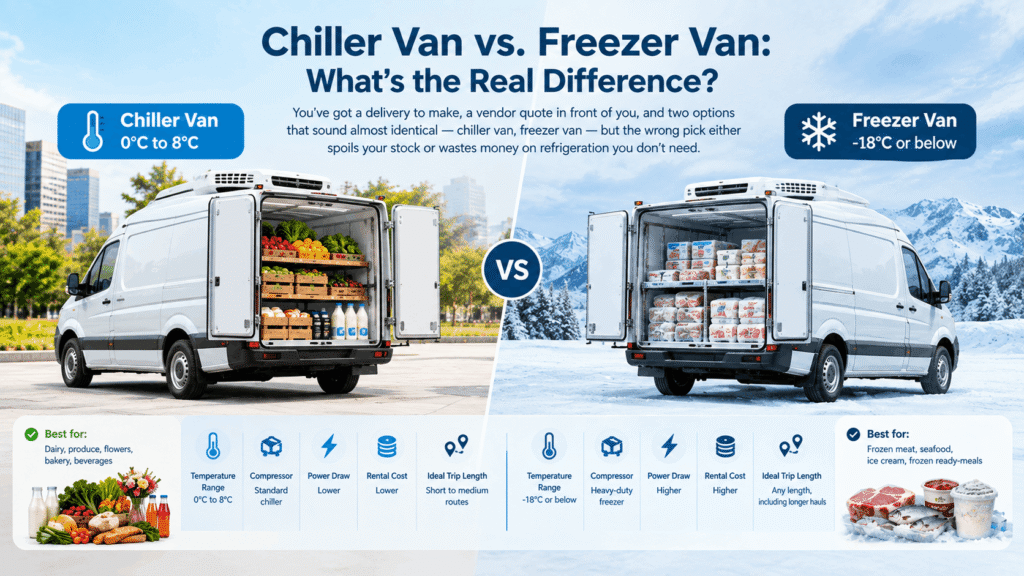
Quick Answer: A chiller van holds goods between roughly 0°C and 8°C for fresh, perishable items like dairy, produce, and flowers. A freezer van holds goods at -18°C or colder for frozen items like meat, seafood, and ice cream. The difference is the refrigeration unit’s capability, not just the insulation — and in Dubai’s heat, that gap matters more than most rental checklists admit.
What You Need to Know
- A chiller van and a freezer van are not interchangeable — using the wrong one can spoil stock within hours in Dubai’s climate.
- Chiller vans run 0°C to 8°C; freezer vans run -18°C or below. That’s the entire technical difference.
- Freezer vans cost more to rent because their refrigeration units work harder and draw more power.
- Some products — mixed pharma-and-food loads, for example — need a specialist consult, not a guess.
- A handful of vehicles offer dual-compartment setups that chill and freeze in the same trip.
Are a Chiller Van and a Freezer Van the Same Thing?
No — a chiller van and a freezer van are built for two different temperature jobs, even though they look identical from the outside. The refrigeration unit inside is calibrated for a completely different range, and that range is the only thing that actually separates them.
People conflate the two because both vehicles are insulated, both have a visible compressor unit, and both get lumped into “refrigerated transport” in casual conversation. In practice, a chiller van that’s asked to hold frozen seafood simply can’t get cold enough, no matter how long you run it.
What’s the Actual Difference Between a Chiller Van and a Freezer Van?
A chiller van maintains 0°C to 8°C for perishable-but-not-frozen goods, while a freezer van maintains -18°C or below for goods that need to stay solidly frozen. That temperature band is the single functional difference between the two vehicle types.
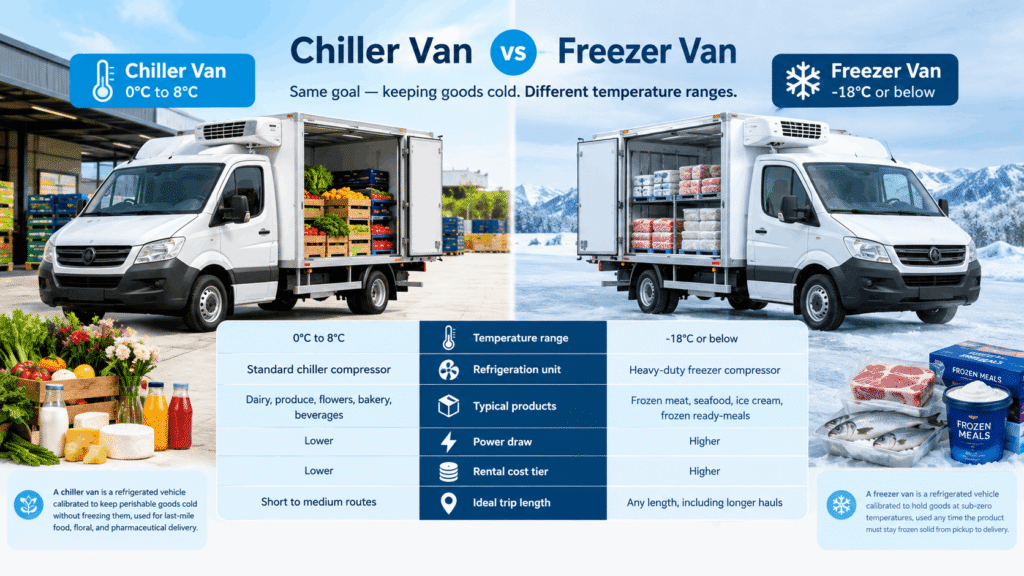
Here’s the comparison side by side:
| Factor | Chiller Van | Freezer Van |
|---|---|---|
| Temperature range | 0°C to 8°C | -18°C or below |
| Refrigeration unit | Standard chiller compressor | Heavy-duty freezer compressor |
| Typical products | Dairy, produce, flowers, bakery, beverages | Frozen meat, seafood, ice cream, frozen ready-meals |
| Power draw | Lower | Higher |
| Rental cost tier | Lower | Higher |
| Ideal trip length | Short to medium routes | Any length, including longer hauls |
A chiller van is a refrigerated vehicle calibrated to keep perishable goods cold without freezing them, used for last-mile food, floral, and pharmaceutical delivery. A freezer van is a refrigerated vehicle calibrated to hold goods at sub-zero temperatures, used any time the product must stay frozen solid from pickup to delivery.
Which Products Need a Chiller Van vs. a Freezer Van?
Match the product to the temperature band it needs, not to whichever van happens to be available that day. Here’s the breakdown we use when a customer isn’t sure which one to book:
| Product Category | Required Temp Range | Van Type |
|---|---|---|
| Fresh dairy | 2°C – 5°C | Chiller van |
| Fresh produce | 4°C – 8°C | Chiller van |
| Fresh flowers | 2°C – 8°C | Chiller van |
| Bakery items | 4°C – 8°C | Chiller van |
| Fresh seafood | 0°C – 4°C | Chiller van |
| Fresh meat (unfrozen) | 0°C – 4°C | Chiller van |
| Frozen meat | -18°C or below | Freezer van |
| Frozen seafood | -18°C or below | Freezer van |
| Ice cream | -20°C or below | Freezer van |
| Frozen ready-meals | -18°C or below | Freezer van |
| Vaccines and pharmaceuticals | 2°C – 8°C (most) | Chiller van (freezer-grade for select biologics) |
Save or screenshot this compatibility chart — it covers the products most Dubai businesses move day to day, and it’s the fastest way to know which van to request before you call a rental company.
Chiller Van or Freezer Van — Which Do You Actually Need?
Pick based on the coldest single item in your load, not the average. One frozen item in an otherwise chilled shipment forces the entire trip into a freezer van, because you can’t run two temperature zones in a standard single-compartment vehicle.
Walk through it this way:
- List every product going in the vehicle. Not the category — the actual items, because “seafood” can mean fresh (chiller) or frozen (freezer) depending on how it left the supplier.
- Identify the coldest requirement in that list. If everything sits above 0°C, you need a chiller van. If anything needs to stay solidly frozen, you need a freezer van.
- Check the route length. Chiller vans handle short-to-medium Dubai city routes comfortably. Freezer vans hold their temperature over longer routes too, but the extra run time adds to the rental cost.
- Confirm with the rental company before booking, especially if your load mixes categories — a five-minute call here prevents a spoiled shipment later.
Can One Van Do Both Jobs?
Some fleets offer dual-compartment vans that run a chiller zone and a freezer zone in the same vehicle, separated by an internal partition. These exist specifically for businesses that regularly move mixed loads — a bakery delivering both fresh bread and frozen dough, for example. Not every rental company stocks them, so ask specifically if your load is mixed.
Why This Matters More in Dubai Than Most Places
Dubai’s ambient summer heat pushes both vehicle types harder than they’d work in a temperate climate, which means the margin for error on choosing the right van is smaller here than almost anywhere else. A chiller van running near its upper limit in a Dubai summer has far less buffer before a temperature breach than the same vehicle would in a cooler market.
This isn’t just a comfort issue — it’s a compliance one. Dubai Municipality’s Food Safety Department enforces documented temperature control for commercial food transport, and UAE Federal Law No. 10 of 2015 on Food Safety sets the legal baseline behind those requirements. Booking the wrong van type isn’t only a spoilage risk — it can also mean arriving without the temperature documentation an inspection asks for.
How Much More Does a Freezer Van Cost to Rent Than a Chiller Van?
Freezer vans typically rent for more than chiller vans because their compressors work harder to hold sub-zero temperatures and draw more fuel or power over the course of a trip. The exact gap varies by rental company, vehicle size, and trip length, so it’s worth getting a like-for-like quote rather than assuming a flat markup.
If you’re weighing the cost difference against your specific route, load size, and how often you’ll need the vehicle, it’s worth getting a direct answer instead of estimating — drop your delivery details with us and we’ll tell you plainly which van type your load actually needs and what it costs to book.
Common Mistakes Businesses Make Choosing Between Them
Assuming “refrigerated” means one single category. Plenty of businesses ask for “a refrigerated van” without specifying chiller or freezer, then get whichever one the company has free that day — which sometimes isn’t the one their product needs.
Booking by product category instead of actual temperature. “Seafood” and “meat” aren’t temperature specifications. Fresh and frozen versions of the same product need completely different vehicles, and this is the single most common mix-up we see.
Not accounting for loading-dock wait time. A van sitting outside in Dubai’s midday heat with its doors open during loading loses cold air fast, even before the trip starts — factor this into which vehicle you request if your loading process takes a while.
Treating dual-compartment availability as standard. It isn’t. Confirm before booking if your load genuinely needs both zones in one trip.
Businesses managing pharmaceutical or medicine deliveries face an even narrower margin for error here — our guide on medicine delivery van rental in Dubai covers what that specific use case requires.
FAQs
Are freezer and chiller the same?
No. A chiller keeps goods cold without freezing them, typically between 0°C and 8°C, while a freezer holds goods at -18°C or below so they stay solidly frozen. They use different refrigeration units calibrated for different temperature bands, and a chiller unit generally cannot reach freezer-level temperatures no matter how long it runs.
What’s the difference between a freezer and a chiller?
A freezer is built to keep products frozen solid at -18°C or colder, while a chiller is built to keep products cold but unfrozen, usually between 0°C and 8°C. The distinction matters because using a chiller for frozen goods lets them thaw, and using a freezer for chilled goods can freeze products that need to stay soft, like fresh produce.
What is the difference between a chiller and a fridge?
A chiller van is a commercial vehicle with an industrial refrigeration unit designed to hold large volumes at a stable temperature across a delivery route, while a fridge is a stationary household or small commercial appliance. Chiller vans also handle far greater temperature stress from repeated door openings and outdoor heat than a standard fridge is built for.
How much does a freezer van cost?
Freezer van rental costs more than chiller van rental because the compressor works harder to sustain sub-zero temperatures, which increases fuel or power consumption over a trip. Exact pricing depends on vehicle size, rental duration, and route length, so getting a direct quote for your specific load is more reliable than relying on a general estimate.
Can a chiller van be used for frozen goods, or a freezer van for chilled goods?
A chiller van cannot reliably hold frozen goods below 0°C, so using one for frozen product risks partial thawing during transit. A freezer van can technically hold chilled-range temperatures, but running it that way wastes the extra power the freezer unit draws, so it’s rarely the efficient choice unless a mixed load needs the colder-capable vehicle.
What to Do Next
If you’re still narrowing down which vehicle fits your specific product mix, our guide on what a chiller van is and how it works breaks down the equipment in more detail. If you want to see why most Dubai food and beverage businesses default to chiller vans for daily deliveries, read why Dubai businesses rely on chiller vans for fresh deliveries.
And if your load includes medicine or pharmaceuticals alongside food or retail goods, check our breakdown of medicine delivery van rental in Dubai before you book — the temperature rules are stricter than most commercial goods.
Ready to book the right one for your load? Send us your product list and route, and we’ll confirm which van type fits before you pay for the wrong one.