
Your delivery just arrived warm, or your supplier keeps mentioning “chiller vans” and you have no idea if that’s what you actually need. Either way, you’re about to find out exactly what this vehicle is and how it keeps your goods cold from pickup to drop-off.

Quick Answer: A chiller van is a delivery vehicle fitted with a refrigeration unit that keeps its cargo area between roughly 2°C and 8°C, the standard range for fresh produce, dairy, beverages, and pharmaceuticals. It works by circulating refrigerant through a compressor and evaporator system, the same principle as a fridge, pulling heat out of the cargo box and pushing cold air back in continuously during transit.
What You Need to Know
- A chiller van holds a chilled range (2°C–8°C), not a frozen range (-18°C and below) — that’s a freezer van
- The cooling system runs on a small compressor cycle, either engine-powered, battery-powered, or both
- Most chiller vans hold safe temperatures for 3–6 hours without power, depending on load and insulation
- In the UAE, requirements vary by cargo type (food vs. pharma vs. flowers) — always confirm with the relevant authority before assuming
- Choosing the right van comes down to matching temperature range and box size to what you’re actually shipping
What Is a Chiller Van?
A chiller van is a light commercial vehicle with an insulated cargo box and a dedicated refrigeration unit built to hold temperatures in the 2°C to 8°C range. It’s the vehicle you reach for when goods need to stay cool but not frozen — think fresh produce, dairy, flowers, beverages, and temperature-sensitive medical supplies.
The name comes from what it does, not how it looks: from the outside, a chiller van can look identical to a standard delivery van. The difference is entirely in the box — insulated panels, a sealed door system, and a compressor unit mounted at the front or roof of the cargo area.
In practice, that insulation is polyurethane foam paneling, typically 50–100mm thick, sandwiched between the cargo box’s inner and outer walls. Thicker panels hold temperature longer but eat into cargo space, so operators pick the thickness based on route length rather than defaulting to the thickest option available. Modern UAE-registered chiller vans also carry digital temperature controllers and data loggers, which record the cargo temperature throughout the trip — useful for your own quality control, and often a requirement for pharmaceutical or export cargo where you need proof of an unbroken cold chain.
What Goods Are Chiller Vans Used For?
Chiller vans are built for anything that spoils in heat but doesn’t need to be frozen solid. That includes:
- Fresh produce — fruit, vegetables, herbs
- Dairy products — milk, cheese, yogurt
- Beverages and bottled drinks
- Fresh flowers
- Pharmaceuticals and medical samples requiring cold-chain compliance
- Catering and prepared food deliveries

If you’re weighing whether a chiller van actually fits your specific goods and delivery pattern, our breakdown of 5 reasons to choose a chiller van for moving your goods covers the practical decision points.
How Does a Chiller Van’s Cooling System Work?
At a direct level: the refrigeration unit removes heat from the cargo box and continuously replaces it with cold air, keeping the internal temperature stable regardless of how hot it is outside.
Here’s the cycle, step by step:
- The compressor pressurizes refrigerant gas. This raises its temperature and pressure, pushing it toward the condenser.
- The condenser releases heat outward. The now-hot refrigerant passes through condenser coils, typically mounted at the front of the unit, dumping heat into the outside air and cooling into a liquid.
- The expansion valve drops the pressure. As the liquid refrigerant passes through this valve, it expands and cools sharply, ready to absorb heat again.
- The evaporator pulls heat from the cargo box. Air inside the van passes over the cold evaporator coils, dropping in temperature before being circulated back into the cargo area by fans.
- The cycle repeats continuously. A thermostat monitors the internal temperature and cycles the compressor on and off to hold the set range, typically checking every few minutes during transit.
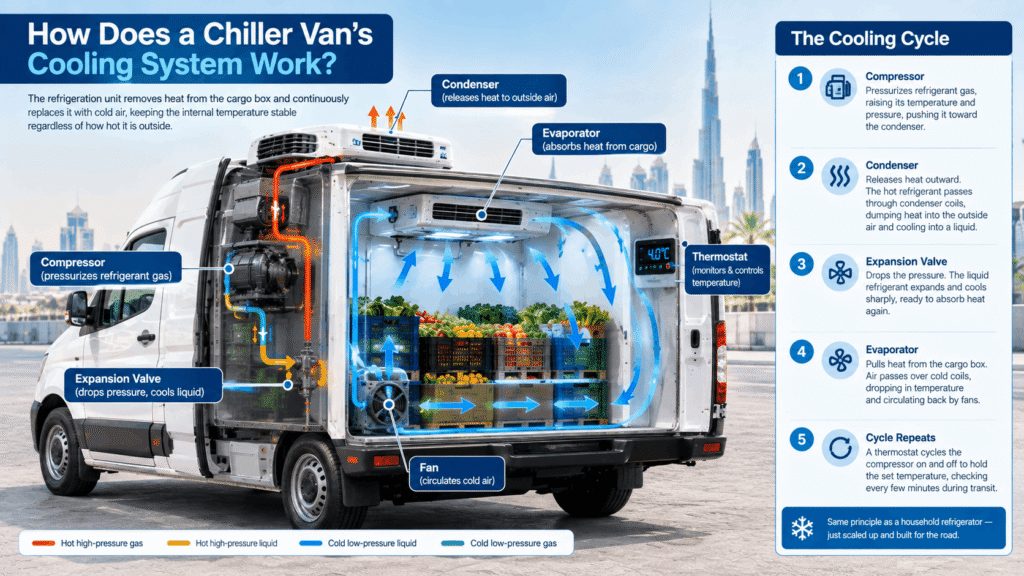
This is the same physics as a household refrigerator — just scaled up and mounted to run off the van’s engine, an independent diesel unit, or a battery pack, depending on the model.
Chiller Van Temperature Reference Table
Save or screenshot this table — it covers the standard settings for the most common cargo types moved in chiller vans.
| Goods Type | Required Temperature Range | Typical Chiller Van Setting | General Guidance on Transit Without Power |
|---|---|---|---|
| Fresh produce (fruit, veg) | 4°C – 8°C | 5°C | Several hours if the box is pre-cooled and stays closed |
| Dairy products | 2°C – 4°C | 3°C | Shorter window; dairy is more sensitive to fluctuation |
| Fresh flowers | 2°C – 8°C | 4°C | Similar to produce; varies by species |
| Beverages | 4°C – 8°C | 6°C | Longer window; less temperature-sensitive |
| Pharmaceuticals | 2°C – 8°C (cold-chain regulated) | Set per product spec | Follow the manufacturer’s cold-chain protocol, not a general estimate |
Note: exact hold times without power depend on ambient temperature, how full the van is, how well it was pre-cooled, and how often the doors open. Treat the figures above as general planning ranges, not guarantees — pharmaceutical cargo in particular should always follow the specific cold-chain instructions for that product.
Chiller Van vs. Freezer Van vs. Refrigerated Truck — What’s the Difference?
| Vehicle | Temperature Range | Best For | Typical Size |
|---|---|---|---|
| Chiller van | 2°C – 8°C | Chilled goods: produce, dairy, flowers, beverages | Small to medium (vans) |
| Freezer van | -18°C or below | Frozen goods: ice cream, frozen meat, frozen seafood | Small to medium (vans) |
| Refrigerated truck | Either range, larger capacity | Bulk chilled or frozen cargo, longer routes | Large (trucks) |
The core distinction is temperature range, not vehicle size. A chiller van and freezer van can be the exact same body style — the only difference is what temperature the refrigeration unit is built and calibrated to hold. If you’re moving mixed frozen and chilled loads, that’s a refrigerated truck question, not a chiller van one — our guide on optimizing frozen food management in a chiller van covers where the line actually sits in practice.
How Long Does a Chiller Van Stay Cold Without Power?
Most chiller vans hold a safe temperature for roughly 3 to 6 hours after the refrigeration unit stops running, assuming the box was properly pre-cooled and stays closed. That window shrinks fast if the doors are opened repeatedly, the van wasn’t pre-cooled before loading, or the outside temperature is high — which matters in the UAE more than almost anywhere else.
Here’s the number that surprises most first-time renters: in Dubai’s summer climate, a standard unrefrigerated van’s interior can climb to 70–80°C within just 20 minutes. That’s not a typo — a closed metal box parked in direct sun heats up almost as fast as an oven. It’s exactly why pre-cooling the box before loading matters as much as the refrigeration unit itself; goods loaded into a van that started at 75°C are fighting a much bigger temperature gap than goods loaded into one that was already sitting at 5°C.
The counterintuitive part: a warm chiller van takes longer to cool down than it does to warm up. Loading room-temperature goods into a van that hasn’t been pre-cooled can mean the refrigeration unit spends the first 30–45 minutes just catching up, during which your cargo sits in the danger zone the whole time.
Do You Need Certification to Operate or Hire One in the UAE?
Requirements depend on what you’re transporting, not just the vehicle itself. Food-grade cargo, pharmaceuticals, and general goods each fall under different compliance frameworks, so there isn’t one blanket certificate that covers every chiller van use case.
For food cargo, the relevant standard is HACCP (Hazard Analysis and Critical Control Points), the internationally recognized framework for identifying and controlling food safety risks across the supply chain, alongside Dubai Municipality’s food transport regulations, which set the local requirements for vehicles carrying food within the emirate. At the federal level, the UAE Ministry of Climate Change and Environment’s food safety framework governs food safety standards more broadly across the country.
Pharmaceutical cargo carries a stricter layer on top of that: GDP (Good Distribution Practice) compliance, which governs how medicines and medical supplies must be handled, stored, and transported to preserve their integrity through the cold chain. Many operators also work toward ISO 22000:2018 Food Safety Management certification, the international standard for food safety management systems, and reference HACCP guidelines published by the FAO/WHO directly.
Rather than assume one rule applies across the board, confirm directly with the relevant authority for your specific cargo type, or ask your rental provider whether HACCP certification and the compliance documentation you need are already built into their process.
Common Mistakes to Avoid
- Not pre-cooling the van before loading. Loading warm goods into a warm box means the unit is fighting an uphill battle from minute one.
- Overloading the cargo area. Packing the van too tight blocks airflow from the evaporator fans, creating warm pockets even when the thermostat reads correctly.
- Leaving doors open too long during multi-stop deliveries. Every open-door minute lets warm air in and cold air out — it adds up fast across a route with many stops.
- Assuming “chiller” and “freezer” are interchangeable. Setting a chiller van to try to hold frozen temperatures either won’t work or will strain the unit well outside its design range.
- Ignoring the temperature log. Skipping temperature checks during transit means you only find out something went wrong after delivery, when it’s too late to fix.
Choosing the Right Chiller Van for Your Business
Once you know your cargo’s temperature range and typical load size, the actual vehicle choice comes down to matching capacity and route length to the job — a small chiller van for short urban deliveries looks very different from what you’d want for a longer multi-stop route. As a starting reference point, a 1-ton Toyota Hiace chiller van in Dubai rents from around AED 220/day, with pricing scaling up from there based on van size and rental length. For the full breakdown across vehicle sizes, see our chiller van rental costs in Dubai for 2026 guide.
Need a Chiller Van in Dubai or the UAE? ChillFreez Transport LLC has operated HACCP-certified chiller vans across all seven UAE Emirates since 2018, serving 750+ businesses with same-day and scheduled cold chain transport.
- WhatsApp: +971 52 549 5268
- Call: +971 52 549 5268
- Email: info@chillfreez.com
- Book online: chillfreez.com/chiller-van-rental-dubai
Frequently Asked Questions
What’s the difference between a chiller van and a freezer van?
A chiller van holds temperatures between 2°C and 8°C for chilled goods like produce and dairy, while a freezer van holds -18°C or below for fully frozen cargo like ice cream or frozen meat. The vehicles can look identical; the refrigeration unit’s calibration is what differs.
What temperature does a chiller van maintain?
Most chiller vans are set somewhere between 2°C and 8°C, with the exact setting depending on the cargo. Dairy typically needs the colder end of that range, while beverages and general produce can sit a few degrees warmer.
How long does a chiller van stay cold without power?
Roughly 3 to 6 hours if the box was pre-cooled and stays closed, though this drops significantly with frequent door openings, high outside temperatures, or a van that wasn’t cooled before loading.
What can you transport in a chiller van?
Chiller vans are used for fresh produce, dairy, beverages, flowers, catering deliveries, and pharmaceuticals or medical supplies that need cold-chain handling but not freezing.
Do I need a special license to drive a chiller van in the UAE?
Driving one generally requires the same license as any comparable commercial van, but operating it for regulated cargo like food or pharmaceuticals may involve separate compliance requirements tied to the cargo, not the vehicle. Confirm with the relevant authority for your specific goods.
How much does it cost to rent a chiller van in Dubai?
Rates start from around AED 220/day for a 1-ton Toyota Hiace chiller van, with larger vehicles and longer rental terms priced higher. For a full breakdown by vehicle size and rental length, see our 2026 chiller van rental cost guide.
What to Do Next
Now that you know how a chiller van actually works, the next question is usually practical: what will it cost you, and does it actually make sense for your business compared to the alternatives. Start with our guide to chiller van rental costs in Dubai (2026) to budget accurately, or read why Dubai businesses rely on chiller vans for fresh deliveries if you’re still weighing whether this is the right fit for your delivery operation.
Want a printable version of the temperature reference table above for your team? [Add your email capture line here — e.g., “Get the full cold-chain temperature checklist sent to your inbox.”]
Published by ChillFreez Transport LLC, Dubai, UAE. Last updated September 2026. ChillFreez is a licensed cold chain transport operator serving Dubai, Abu Dhabi, Sharjah, Ajman, Ras Al Khaimah, Fujairah, and Umm Al Quwain.
Pingback: Chiller Van vs Freezer Van: The Real Difference (Dubai)